We are going to the East -- a letter from Fr. Allen

adoration-clipart-chalice.jpg

+JMJ+

Dear friends,

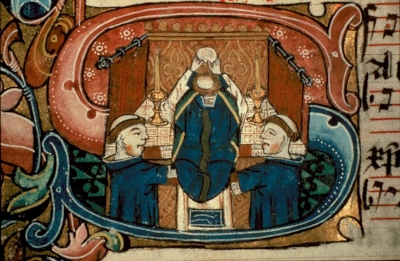
The image [shown below] at the top of this week's newsletter is from the 15th century Ranworth Antiphoner (an antiphoner is a book of Mass and Office chants for use by the choir). One thing we might notice right away is that the priest is celebrating the Mass ad orientem, or, "to the East." That is, he is standing on the same side of the altar and facing the same direction as the (presumed) congregation, as is our custom at Corpus Christi and is indeed normal throughout the Ordinariate (and is actually normative, though not normal, throughout the Church).
I bring this up because of today's saint: St. Teresa Benedicta of the Cross; or, as she more usually know, St. Edith Stein. Edith Stein was a Jew, a convert from Atheism, a professor of philosophy, and a Carmelite nun, murdered by the Nazis in the gas chambers of Auschwitz on 9 August 1942. Bishop Barron has a short but insightful reflection on her life and witness here, in the course of which he relates this story of her forced journey to Auschwitz:

'The sisters were held briefly in a camp in Holland and then were packed onto what amounted to a cattle car for the trip to Auschwitz. A former student of Edith’s reported an encounter with the nun when the train stopped briefly at a platform in Germany. After greeting her, Edith asked her to convey a message to the mother superior in Echt: “We are going to the East,” a sentence with both a literal and a spiritual meaning. She was undoubtedly trying to communicate information about their geographical destination, but “the East” is also mystical language for heaven and eternal life...'

"We are going to the East." The saint's statement reflects her firm belief, her "sure and certain hope" in the resurrection of the body and the life of the world to come. This is precisely why in the churchyard at St. Mary's, with only two recently added exceptions, all 338 of the graves face east - that is, the direction of heaven and the returning Lord. Churches anciently were always build so that direction of prayer was toward the east. (St. Mary's is oddly oriented - meridianated? - to the south; I suppose this is due the exigencies of 18th century property availability.) I haven't done the research, but it's unlikely that St. Edith Stein ever attended Mass except facing literal east. For her, "going to the East" was going to the Lord.

Long ago, St. Augustine put it this way: 

"When we rise to pray, we turn East, where heaven begins. And we do this not because God is there, as if He had moved away from the other directions on earth..., but rather to help us remember to turn our mind towards a higher order, that is, to God."

This is why we celebrate Mass ad orientem (even if only figuratively). With Edith Stein and aided by her prayers, and with all the Church, "we are going to the East," and every Mass is another step in our journey to meet our Lord.

God bless you, 
Fr Allen

P.S. Please remember that Wednesday, 15 August, the Assumption of the Blessed Virgin Mary, is a holy day of obligation.

Update: Regarding the scandal involving Cardinal Theodore McCarrick about which I have previously written to you, I recommend the following letters and articles:


A Homily Thread on the Transfiguration

August 6 is the Transfiguration of the Lord


Collect of the Day  O God, who on the holy mount didst reveal to chosen witnesses thine Only Begotten Son wonderfully transfigured, in raiment white and glistening: mercifully grant that we, being delivered from the disquietude of this world, may be permitted to behold the King in his beauty; who with thee, O Father, and thee, O Holy Ghost, liveth and reigneth, ever one God, world without end. ℟ Amen.

Happy Feast of the Transfiguration!

So what is it about the Transfiguration that should be so encouraging, so enlightening? Well, we were eyewitnesses of his majesty, Peter says. His majesty. Peter knew and had followed Jesus, the mostly homeless and itinerant rabbi.

And for all the power of his teaching, and even the miracles he had witnessed, Jesus is still, far as Peter can see, subject to all the usual and unjust earthly powers and authorities.

After all, just a week prior to this, Jesus had announced his intention to go to Jerusalem, where Peter and the other Apostles are sure he, and probably they as well, will be killed. “Let us go with him that we may also die with him,” Thomas says.

And Peter himself tries to prevent Jesus from going, only to have Jesus say, “get behind me Satan.” Peter is worried. Jesus is taking them to a dark and dangerous place.

But before Jerusalem, before Mt Calvary, Jesus takes Peter and these other “chosen witnesses” up Mt Tabor, and there the veil of dust and care and time and frail, oriented-to-death human flesh is pulled back for just a few minutes, and the Apostles see, and we by faith see with them, the Incarnate Son of God in his eternal glory. That is, we see his glorified humanity - which is our own humanity, in perfect and complete union with his divinity.

In other words, in the Transfiguration, the Apostles received a glimpse, a foretaste, of Christ’s victory, and they see their own potential, the potential of every single human being who is united to Christ by faith and baptism.

As St Irenaeus said all the way back in the second century, in Christ “God became what we are in order to make us what he is himself." In Christ, our own humanity, purified by grace from every spot and stain of sin, may have a share in divinity, in the eternal life and light of the Most Blessed Trinity.

And with that hope, and keeping our eyes on that prize, we may have courage to face up to what our collect, with affecting understatement, calls, “the disquietude of this world.”

Hell and its fruit: a summer meditation on watermelon, the real God, and community

image source: PardeevilleWatermelonFestival.com 

image source: PardeevilleWatermelonFestival.com 

We all have our private metrics by which we determine the rate at which Western Civilization is declining, civil society deracinating and withering, and the world generally going to hell in a hand basket. I know this because there are curmudgeons in our midst (to be carefully distinguished from gorillas in the mist) who keep me informed. For some, the slide down into a well deserved cultural oblivion can be measured by the number of grammatical errors in The Post and Courier, for others in the sartorial standards of "kids today," and for still others (and you know who you are) in the ratio of video screens to hymnals and prayer books in Episcopal parishes.

Though not so curmudgeonly as some, I, too, try to read the signs of the times, and there is one sign I pay particular attention to each summer and which, I regret to report, bodes ill for truth, justice, and my way. I refer to the price of watermelons: $5.99 apiece this week at the Piggly Wiggly. Who ever heard of a six dollar watermelon? Six dollars! And not only are these melons exorbitantly priced, they are defective. They are "seedless." Leaving aside the botanical perversity of a fruit without seeds (cf. Gn 1.11), one of the great pleasures of watermelon eating is spitting the seeds over the porch rail or, perhaps, at one's sister, with points awarded for distance and accuracy.

image source: whataboutwatermelon.com 

image source: whataboutwatermelon.com 

And I'm afraid things are much worse than even a contrary-to-the-Divine-intent six dollar seedless watermelon would indicate. Because there, in a bin just next to the contrary-to-the-Divine-intent six dollar seedless watermelons, are, I kid you not, "personal watermelons," also without seeds. This is a small cultivar, about the size of an anemic cantaloupe, intended for consumption by one.

The personal watermelon is a signpost on the way to a particularly modern kind of hell - albeit, like Eve's apple, a delicious one.

Enabled by the incredible potencies of digital technology and urged on by marketing marksmen, we live in an age of ever-increasing personalization and, inevitably, privatization.   

This past spring, I happened to be driving late one afternoon down Calhoun Street past the MUSC bus stop. There must have been 25 or 30 people waiting on the bus, sitting along the low wall, and all of them – every single one of them – were hunched over, staring at the small screens of their smartphones, most with earphones. Here were people who worked in the same locale (if not actually together), who apparently lived in the same part of town, who at least had certain transportation needs or priorities in common, yet were not sharing stories, asking after one another's children, or making plans to get a beer together. They were 30 people together, but altogether alone, though their personal tastes – in music, in news, in reading – were being meticulously catered to through the magic of digital technology.

It is an isolating dynamic to which we middle class Americans, raised to be consumers, are particularly liable. In 2005, the sociologists Christian Smith and Melinda Lundquist published Soul Searching: the Spiritual Lives of American Teenagers (Oxford University Press), in which they famously described the religion of young people (which they learn from their parents and in their churches) as "Moral Therapeutic Deism." They described this religion's god as,

"... primarily a divine Creator and Law giver. He designed the universe and establishes moral law and order. But this God is not Trinitarian; he did not speak through the Torah or the prophets of Israel, was never resurrected from the dead, and does not fill and transform people through his Spirit. This God is not demanding. He actually can't be, since his job is to solve our problems and make people feel good. In short, God is something like a combination Divine Butler and Cosmic Therapist."

"A Divine Butler and Cosmic Therapist" – in other words, a very personal and private Lord and Savior. There is, of course, a very important truth in the evangelical Protestant language of "personal Lord and Savior": I am a sinner, and I must repent, and I can and must because, it is true, Jesus loves me. But it is an easy slide into conceiving of a god who exists to serve me and my needs, to make me feel better about myself (absent any need for repentance), and who would not dare question, and wouldn't want me to question, the dictates of my own private judgment.

But the Gospel calls us out of ourselves and towards our neighbor. Jesus is the common Lord and Savior of all Christians, and we serve him together in his Church, which is his Bride – his one and only Bride, for, as it has been said, our Lord is no polygamist. He is calling us together into a new community of love, which is personal (real love always is) but not particularly private, because it is and must be shared. To prepare for that heaven, we must push back against the encroachments of our modern isolating hell. The place to begin, of course, is to share with our brothers and sisters in the Communion of Christ's Body and Blood at Mass. And perhaps a good second step is to share with friends and neighbors a very large, public, and social watermelon, complete with seeds, on a sunny summer Sunday afternoon.

-- Fr. Patrick Allen

image source: PardeevilleWatermelonFestival.com 

image source: PardeevilleWatermelonFestival.com 

Fr. Allen addresses the Cardinal McCarrick scandal

adoration-clipart-chalice.jpg

+JMJ+

Dear friends,

In last Sunday's first reading, we heard the word of the Lord by the Prophet Jeremiah:

'Woe to the shepherds who destroy and scatter the sheep of my pasture!' says the Lord.

These last weeks have seen new revelations of shepherds within the Church who destroy and scatter the sheep. Cardinal Theodore McCarrick, the retired Archbishop of Washington D.C., has been credibly accused of sexually abusing minors and prohibited from exercising any public ministry. These accusations of abuse against minors have become the occasion, though, for the public airing of many more charges against the Cardinal - namely, that he was a sexual predator who used his position of power to coerce seminarians into sexual relationships, essentially purchasing their silence. It also turns out that two of his former dioceses paid settlements to men who accused the Cardinal of sexual harassment. But most distressing of all, it is now plain that many within the Church, including bishops, knew of McCarrick's proclivities but did nothing to stop him or prevent his rise through the ecclesiastical ranks. I myself have talked to priests who had heard these rumors decades ago when they themselves were seminarians. Journalists had verified these rumours but could get no one to go on record. When McCarrick was named Archbishop of Washington, a delegation of well-placed Catholics went to Rome to warn curial officials at the Vatican of McCarrick's abuse, and still no one acted. In short, everyone knew.

Here is a New York Times piece reporting on the accusations against McCarrick (warning: it is horrible to read). Here is a helpful analysis from the Catholic News Agency. I encourage you to read both.

As I say, it is distressing. It was painful for me as a Protestant contemplating conversion to the Catholic Church in 2002 when the abuse scandal here first exploded, and it is more painful now, as a Catholic and a priest, when it seems like 2002 all over again. But Jeremiah's invective against Israel's false shepherds reminds us that there is nothing new under the sun. It also tells us that God will judge our false shepherds. So while rightly distressed, we do not despair. We must pray that God will do whatever, and to whomever, is necessary to purify the Church from this filth in our own time, and especially that he would strengthen our bishops, who are our chief shepherds and pastors, to act boldly and transparently. We must pray for that, but we must also demand it from the bishops.

I am sorry to have to write to you about these things, but it is important for the good of the Church that you know, understand, pray, and act. And yes, there are many wonderful things happening in the Church and, indeed, in our own midst, and so we may pray with Jeremiah (who was not always weeping): 

It is of the Lord's mercies that we are not consumed,
because his compassions fail not.
They are new every morning: great is thy faithfulness.
The Lord is my portion, saith my soul; therefore will I hope in him.

Kyrie eleison.

God bless you,

Fr Allen

[Editor's note: in Fr. Allen's weekly letter to his parishioners on 9 Aug 2018, he referenced his letter from 26 Jul (above) and added the following.]

Update: Regarding the scandal involving Cardinal Theodore McCarrick about which I have previously written you, I recommend the following letters and articles:

Fr. Allen on the 50th Anniversary of Humanae Vitae

adoration-clipart-chalice.jpg

+JMJ+

Dear friends,

This coming Wednesday, July 25th (the Feast of St James), will mark the 50th Anniversary of Pope Paul VI's encyclical Humanae vitaewhich again confirmed the Church's perennial teaching concerning the vocation of marriage, including that sexual relations are ordered toward procreation, and so contraception is contrary to God's will and objectively sinful. Again, this is the Church's perennial teaching; it was not new or even a development of previous teaching when Humanae vitae was published. (Interestingly for us Catholics of Anglican background, that teaching had last received magisterial reaffirmation in Pope Pius XI's 1930 encyclical Casti connubii, issued in response to the 1930 Lambeth Conference of Anglican bishops, which had abandoned that perennial teaching with cascading consequences we know only too well.)

The prohibition of contraception marks the Church, like her Head whose Body she is, as a "sign of contradiction" in the modern world. Sexual pleasure and "freedom" is seen by most in our time as a - or even the - fundamental good to which all humans are entitled, to be had at one's whim and without any natural consequences, be emotional, relational, or biological (i.e., babies). But even among married Catholic couples striving to be faithful, and many others of good will as well, for whom sex is a unitive good and "mutual joy" within marriage, this teaching has proven difficult to receive and live out.

But its difficulty can be in no way a strike against its truth - indeed, why would we expect it to be? What is good in this fallen world is often difficult, and we would expect a good which sits so close to the center of our humanity - the love between husband and wife, the begetting and raising of children - to be obtained only with difficulty and, ultimately, when carried along by God's grace. But conformity with the truth is the only true freedom and always worth striving after. And the dire consequences, for individuals and our society, and especially for women and children, of living against the grain of God's truth are increasingly plain for all to see (cf. the articles by Mary Eberstadt linked below).

I often hear it said that, because they are unmarried, Catholic priests have no credibility when it comes to counseling married couple in this area. Well, that has always seemed silly to me. Chastity is chastity, and it seems obvious that those who are perpetually celibate might indeed have something to say to those who, for the sake of spacing children and cooperating with nature, might be only intermittently and briefly celibate. But, for what it's worth, I am a married Catholic priest, and happy to offer whatever counsel I may to Catholic couples who desire to order their sexual lives in accord with God's will, including of course the Sacrament of Reconciliation. I believe this difficult teaching of the Church is true and that it is a way to happiness and wholeness.

In the meantime, here are a couple resources to help those who want to understand the Church's teaching in this matter:

Again, I'm happy to talk (confidentially!) with any of you who wish to pursue this further, and to offer whatever pastoral and sacramental support I may as we all seek to live in to the beautiful truth of God's design for our bodies, for our families, for the Church.

God bless you, 
Fr Allen

Letter from Fr. Allen: July 12, 2018

adoration-clipart-chalice.jpg

+JMJ+

Dear friends,

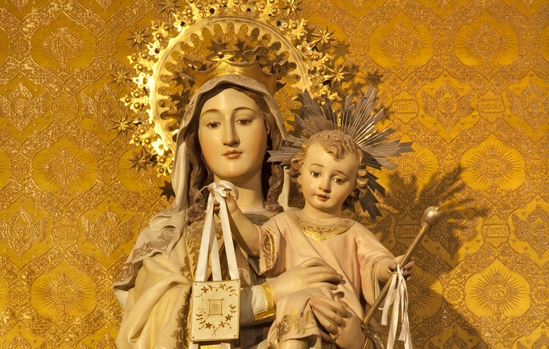
In the image [below], our Infant Lord, seated in the lap of our Lady, holds an orb surmounted with a cross. This is not, as has been suggested by one or two of our parishioners, the "Holy Hand Grenade of Antioch." Rather, it is properly known as a globus cruciger, which simply means "cross-bearing orb." From the middle ages, it has represented Christ's lordship over the orb of the world. Iconography in which Jesus is depicted holding the globus cruciger is called a Salvator mundi ("Savior of the World"). Last year an idiot (I use the term advisedly) paid $450 million dollars for a Salvator mundi that may, or may not, be the work of Leonardo DaVinci. In fact much of the argument among art historians centers on the orb in that picture, which some experts feel is not up to Leonardo's usual standard.

In any case, images of Christ as Salvator mundi depict an important truth, which we need always before our eyes, straining as we sometimes do to see God's kind providence in this dark and fallen world. Christ is Redeemer of the world and reigns over the world, and he is bringing all things to their perfect consummation. Christ is, as St Paul writes to the Ephesians, "head over all things for the Church" (Eph 1.22).

In other words: he's got the whole world in his hands.

God bless you, 
Fr Allen

Our Lady of the Atonement 

Our Lady of the Atonement